COMMUNIQUÉ
Issued at the Conclusion of the Three-Day Medical Education and Innovation Workshop
Faculty of Medicine, College of Health Sciences
Nnamdi Azikiwe University, Nnewi Campus
PREAMBLE
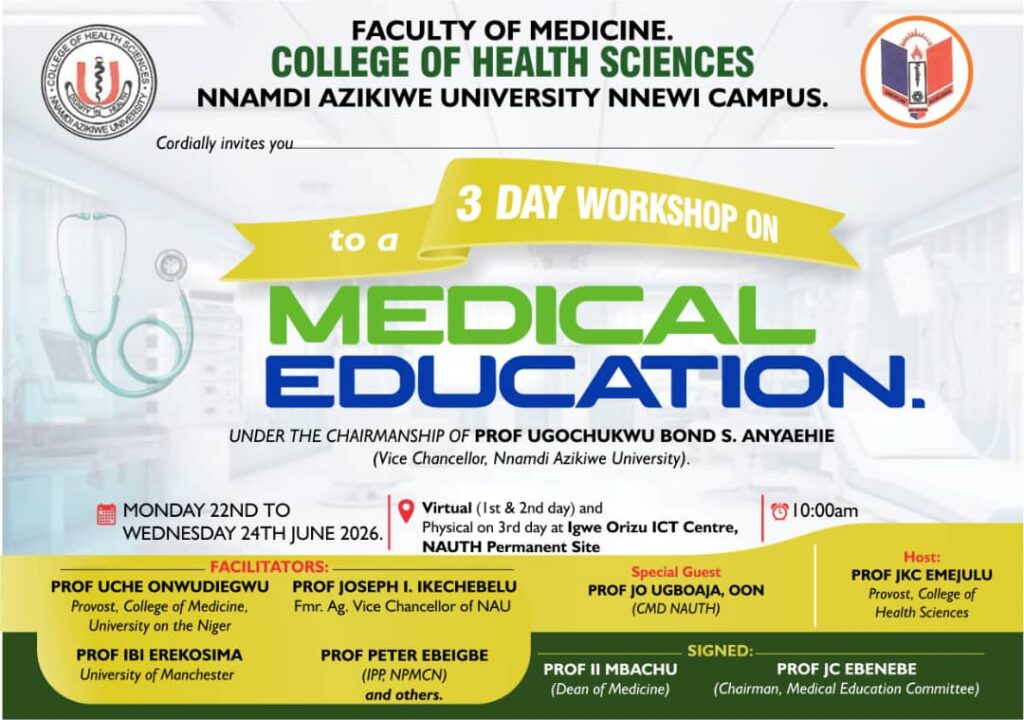
The Faculty of Medicine, College of Health Sciences, Nnamdi Azikiwe University, hosted a Three-Day Medical Education and Innovation Workshop from 22nd to 24th June 2026. Sessions on Days 1 and 2 were conducted virtually, whilst Day 3 convened in person at the Nnamdi Azikiwe University Teaching Hospital (NAUTH) Permanent Site, Nnewi.
The workshop brought together medical educators, clinicians, academic leaders, and institutional stakeholders with the overarching aim of strengthening faculty capacity in contemporary medical education, student assessment, curriculum development, mentorship, and educational innovation.
Distinguished resource persons drawn from Nigeria and the international academic community delivered lectures, facilitated practical sessions, and led discussions on global best practices in medical education. The faculty of resource persons comprised:
- Prof. Ibi Erekosima — University of Manchester, United Kingdom
- Prof. Uche Onwudiegwu — University of the Niger, Nigeria
- Prof. Joe Ikechebelu — Nnamdi Azikiwe University, Nigeria
- Prof. P. N. Ebeigbe — Delta State University, Nigeria
- Prof. Ikechukwu Onyenwe — Nnamdi Azikiwe University, Nigeria
The workshop concluded with hands-on training in Objective Structured Clinical Examination (OSCE) blueprinting and checklist development, reaffirming the Faculty’s sustained commitment to excellence in medical education.
The workshop was formally opened by the Dean, Prof Ikechukwu I. Mbachu, who underscored the imperative for medical education to evolve in step with advances in medicine, particularly in the domains of teaching methodology and student assessment. He commended the organising committee, led by Prof Joy Ebenebe, for the quality and coordination of the event.
The Vice-Chancellor of Nnamdi Azikiwe University, Prof Ugochukwu Bond Stanley Anyaehie, was represented by the Provost of the College of Health Sciences, Prof J.K.C. Emejulu, who emphasised the necessity of innovative curricula and reaffirmed the University’s institutional commitment to advancing medical training.
WORKSHOP HIGHLIGHTS
The workshop underscored the urgent need to transform medical education in response to the evolving demands of healthcare delivery, with emphasis on competency-based, learner-centred, and technology-driven approaches.
Participants deepened their understanding of the principles underpinning assessment for learning and assessment of learning, with sustained focus on validity, reliability, fairness, and the constructive alignment of assessment methods with intended learning outcomes. The centrality of professionalism, lifelong learning, and continuous quality improvement in medical education was strongly affirmed throughout.
Extensive sessions addressed the Objective Structured Clinical Examination (OSCE), encompassing its design, implementation, blueprinting, examiner calibration, and checklist development, as well as strategies for enhancing its validity, reliability, and discriminatory power. Participants recognised the superiority of competency-based assessments over conventional examination methods and affirmed the OSCE as an indispensable instrument for evaluating clinical competence.
The workshop further examined innovations in Electronic OSCE (E-OSCE), demonstrating the capacity of digital technologies to enhance examination efficiency through real-time scoring, automated result collation, improved transparency, quality assurance, and timely feedback. Participants were introduced to a locally developed E-OSCE platform and its potential to transform clinical assessment practice.
Sessions on curriculum design reinforced the case for competency-based curricula, active learning strategies, early clinical exposure, the integration of communication skills, and adherence to adult learning principles. The SPICES model, Bloom’s Taxonomy, and contemporary pedagogical frameworks were examined as tools for improving curriculum delivery and assessment design.
Mentorship and effective feedback were highlighted as indispensable components of faculty development and learner success. Participants were encouraged to cultivate structured mentoring relationships, reflective practice, learner-centred feedback, and professional role modelling within the medical school environment.
A practical component required participants, working in departmental groups, to develop OSCE blueprints, checklists, and examination stations — providing direct, hands-on experience in the design of high-quality, competency-based assessments.
RECOMMENDATIONS
The workshop resolved as follows:
- The Faculty should institutionalise periodic faculty development programmes encompassing medical education, assessment, curriculum development, mentorship, and educational innovation.
- Competency-based curricula should be fully implemented and subjected to regular review in order to remain aligned with evolving healthcare needs and international standards.
- The Objective Structured Clinical Examination (OSCE) should be adopted as the standard method for assessing clinical competence across undergraduate and postgraduate medical programmes.
- Strategic investment should be directed towards clinical skills laboratories, simulation facilities, and Electronic OSCE technologies to enhance the quality and efficiency of clinical assessments.
- Continuous training and calibration of examiners should be institutionalised to ensure the fairness, reliability, and validity of assessments.
- Structured mentorship programmes and effective learner-centred feedback mechanisms should be integrated across all medical training programmes.
- A centralised question bank, standardised blueprinting process, and routine item analysis should be developed to strengthen overall examination quality.
- Interdepartmental collaboration, as well as partnerships with national and international institutions, should be actively promoted to advance innovation, educational research, and the exchange of best practices in medical education.
CONCLUSION
The Three-Day Medical Education and Innovation Workshop successfully achieved its objectives, enhancing the knowledge and practical competencies of medical educators in contemporary teaching, learning, curriculum development, and assessment. Participants unanimously affirmed the need for continuous innovation, faculty development, and sustained institutional commitment to producing competent, ethical, and globally competitive healthcare professionals.
The Faculty of Medicine, Nnamdi Azikiwe University, Nnewi Campus, reaffirms its commitment to implementing the recommendations arising from this workshop, with the aim of strengthening medical education and improving healthcare outcomes in Nigeria and beyond.
Prof J. C. Ebenebe
Chairman, Medical Education and Innovation Committee
Prof I. I. Mbachu
Dean, Faculty of Medicine